
Go for 'C'...

Hello Awesome Human,
When I think about how I can help you the most, I want to write you an ABC or a 123. Do these things, and everything will turn out just fine. The truth is that the answers aren’t that straightforward; they aren’t black and white. There is nuance necessary for your family that will be different to mine or someone else’s. It is much more helpful to think in terms of principles that you can apply to your own situation. Today, I am sharing some of those principles that begin with ‘C’.
This email is one to be dipped into. Perhaps just take one idea and think about how it relates to you. This isn’t a prescription; it is a space for reflection.
Going for C
Our adult son recently returned from a holiday he really enjoyed, and the two days after his return, he was in the depths of a come-down and really miserable. Whilst he was in that state, I beautifully illustrated the first principle I want to share with you today. I was a C-grade parent.
I didn’t float calmly around. I was irritated that he didn’t seem to try to adjust his sleep times, and frustrated that he didn’t want to engage with us. I didn’t shout or rant, but I equally didn’t address the situation with any finesse. I did what I was capable of, and frequently that is the best any of us can expect of ourselves.
When we aim for A-grade parenting, we will only end up feeling like a failure and potentially be frustrated with ourselves, in addition to the situation we are dealing with.
One of the things I love about being ok with being imperfect is that it sends a helpful and compassionate message to the people around us. It says you don’t have to be perfect to be ok. Good enough really is good enough.
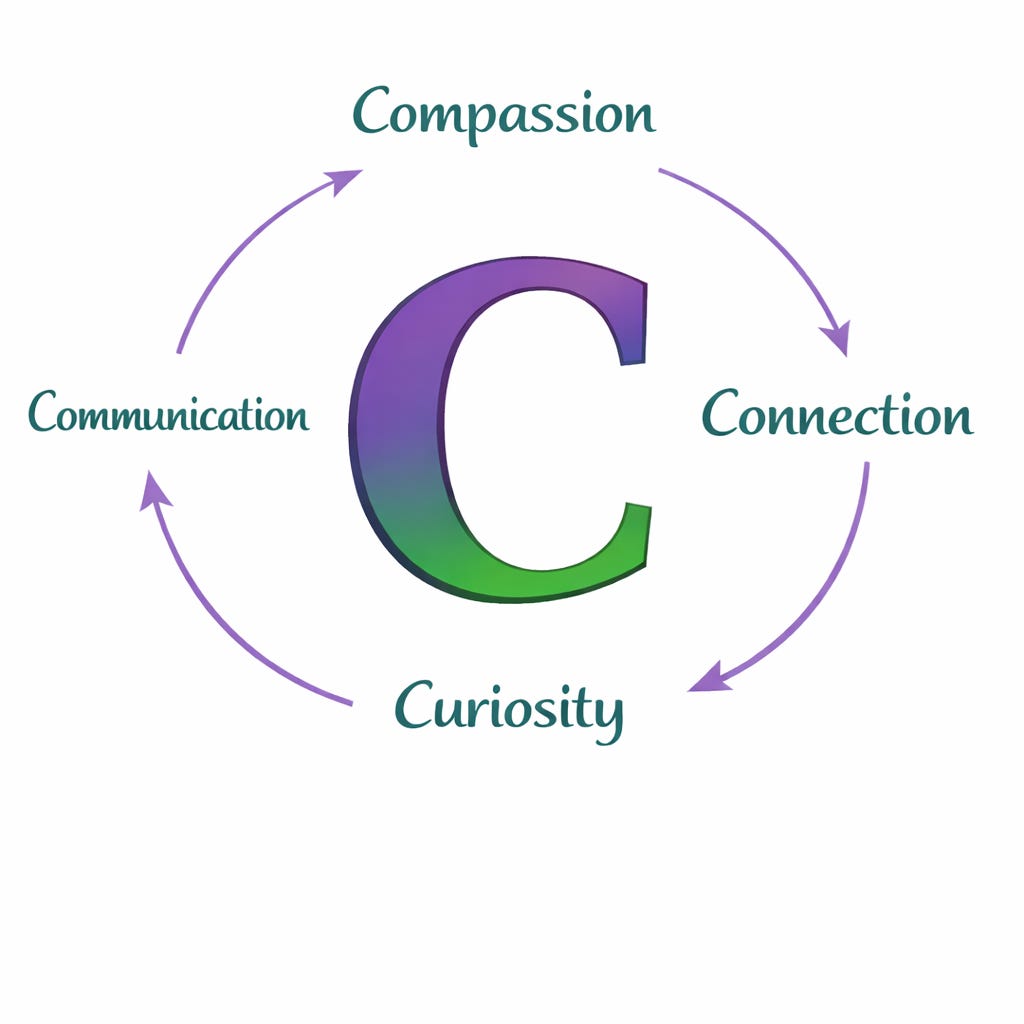
Compassion
Compassion is a truly helpful foundation for life (not just supporting your child with an eating disorder). Kindness and caring for ourselves and others. I am sure you have had people tell you that, as a carer, you need to take care of yourself. I believe that to be true. Being compassionate to yourself is a way to do that. Compassion requires that we notice, feel, and respond. If you notice how you are and what you are feeling, then give yourself what you need with kindness; you are displaying compassion for yourself.
Bringing compassion to yourself and your loved ones will make the recovery journey more easeful. When you find yourself feeling stuck, angry or agitated, you might ask, ‘What would I do if I were being compassionate?’ Compassion is a key component of emotional regulation and will help both you and your child.
Connection
The New Maudsley programme for carers encourages ‘connection before correction’. Rarely do any of us want to be told what to do. When we correct someone, it can be received as criticism or perceived as a sign of inadequacy. If we do it too often if can be heard as nagging. If what we want with our child is a relationship in which we can support them, the focus needs to be on connection.
We connect by listening to someone, by understanding some of what they are experiencing. When we demonstrate that they are seen and heard, they are more likely to feel connected. Reflecting back on what you are observing, you may describe what you see: ‘your shoulders are hunched up, and your fists are clenched. I am guessing you are angry right now?’ ‘The look on your face makes me think you are very worried about this. Have I got that right?’
Make it clear that you are guessing what they are feeling rather than assuming you know.
Sometimes, connection isn’t about verbal communication. It may be a hand on someone’s arm, a pat on the shoulder or a hug. It may be a Post-it note with a heart on it or a wink or nod that says ‘I’ve got it.’
Curiosity
Curiosity is an element of connection, yet it is significant enough to be considered on its own. Curiosity reminds us that we don’t know everything. It invites us to explore other possibilities. It encourages us to explore other perspectives, and in addition to creating connection, it provides opportunities for different approaches and solutions.
Often curiosity means asking questions: ‘Can you explain to me why you think/ feel that?’ ‘I hadn’t thought of it that way. Can you tell me more?’ ‘What do you think would be helpful?’
Sometimes curiosity means being open to waiting a bit longer or experimenting with something to see what the outcome is.
Curiosity is the opposite of black-and-white thinking. It says there may be another perspective here; it is possible that we can agree to disagree. There is no right or wrong, just different opportunities.
I encourage curiosity not just with your child with an eating disorder, but with the rest of your family and particularly with your child’s treatment team. I often work with parents who don’t agree with some of the team’s opinions. When they bring curiosity to that situation, there is often an opportunity to share their views, which can lead to a more helpful outcome.
Communication
To provide a space for recovery, we need effective communication. This is multifaceted. It refers to communication with ourselves, our loved ones, our wider family, the people around us, and, of course, the treatment team.
We communicate in all sorts of ways. Verbal and non-verbal. Whether we value ourselves enough to be compassionate to ourselves. Whether we do for everyone else before ourselves. Whether we answer things calmly or clearly worry all the time.
We communicate through our actions and demeanour. We communicate through what we say and how we say it. All of these things matter, and compassion, connection and curiosity contribute to communication.
Here are just two of the posts I have written about communication:
We Create with our words - talks about the importance of the content of our communication.
Reassurance isn’t harmless - it explains how things that seem harmless can be unhelpful.
Don’t underestimate the small stuff; think broadly about other ways to tell someone you care. My son was too grumpy to talk, but sending him a WhatsApp to let him know I was there if he needed to chat made a difference.
I’d love to know your thoughts. If anything I have written here resonates with you or grates, please let me know.
Sending so much love,
Ruth xxx
You can work with me in several ways:
One-to-one, either online or face-to-face (near Cardiff, UK)
The Recovery Cwtch is an online support group for parents who have a child with an eating disorder. We meet weekly and have a WhatsApp group where we can share wins and dilemmas in real time.
I run The New Maudsley Skills-Based Training: Caring for a Loved One with an Eating Disorder. Please message me to find out when the next one is.
Would you like more awareness of eating disorders in a school or your workplace in the UK? Please get in touch with me to discuss how I can assist you.
Would you like your school, university, or youth club to run an eating disorder prevention programme (The Body Project) for its young people? If so, please get in touch.
To discuss any of the above, book a free find-out call with me: